
Structural Drying After Water Damage in Frisco, TX
Water extraction is only the starting point. Our IICRC Applied Structural Drying (ASD) certified team removes hidden moisture from walls, subfloor, and framing down to a verified, documented, pre-loss dry standard.
- IICRC ASD Certified
- Psychrometric Drying Plans
- Daily Moisture Documentation
- 24/7 Emergency Response
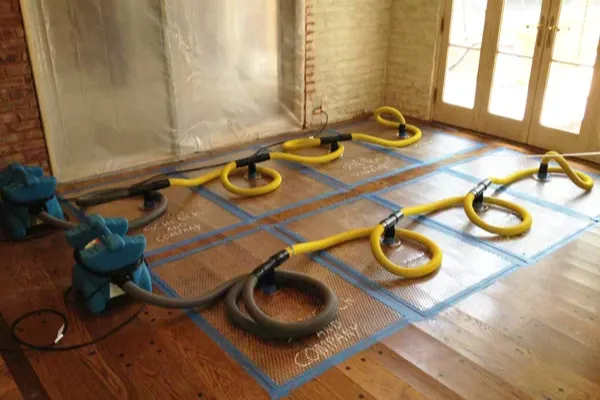
structural drying
Isn’t removing the water enough?
No — extraction is only step one. Moisture that’s already wicked into drywall, subfloor, and framing stays behind and feeds mold within 24 to 48 hours, even when the surface looks dry. Structural drying is what actually finishes the job.
CertifiedIICRC Applied Structural Drying credential, hands-on tested.
DaysTypical drying timeline, depending on damage class.
Why Structural Drying Gets Skipped — And Why We Never Skip It
Visible water is only a fraction of the total moisture intrusion. Within the first hour of contact, moisture moves far past what you can see.
- 1Drywall absorbs fastMoisture soaks through the paper facing within the first hour of contact.
- 2Wood swells along the grainSubfloor panels and framing take on moisture that a surface wipe never reaches.
- 3Concrete wicks upwardWater travels through microscopic pores, well past what looks dry on top.
- 4Wall cavities trap vaporMoisture condenses on cooler surfaces inside the wall, invisible from the room.
In Frisco’s humidity: opening a window doesn’t dry your home — with summer humidity regularly topping 70–80%, it adds moisture instead. Our equipment pulls moisture out faster than the environment can replace it.
The Science We Use to Dry Your Home
Structural drying is the controlled relationship between air, temperature, and moisture. We manage all four variables on every job.
Temperature
We work drying zones into the 70°F–90°F range so warm air can absorb more moisture from wet materials.
Relative Humidity
Industrial LGR dehumidifiers drive RH below the 40% threshold the IICRC S500 calls for.
Airflow
High-velocity air movers run a vortex pattern — at least one per 50–70 sq ft of affected floor.
Vapor Pressure
Continuously lowering air RH creates the pressure differential that pulls moisture out of walls and framing for good.
Built for Frisco’s Climate
Frisco throws a few specific challenges at a drying job, and our approach is built around them.
High Summer Humidity
With outdoor RH at 60–85%, we run warm-weather jobs as a closed system — sealed, with dehumidifiers holding interior RH below outdoor levels.
Winter Freeze-Thaw Breaks
Below 20°F we see fast-moving, multi-room losses. We deploy desiccant units, effective from 0°F to 120°F, when refrigerant units lose efficiency.
Reactive Clay Soil
Ground movement stresses slabs and pipes. Slab leaks push moisture into concrete itself — a Class 4 scenario needing specialty mats and 7–14 days.
Newer, tighter construction — in subdivisions like Phillips Creek Ranch, Panther Creek, Starwood, and The Grove, energy-efficient envelopes trap moisture aggressively, so we size equipment more aggressively to compensate.
Signs Your Last Drying Job Wasn’t Done Right
If you’ve had water damage restored before and see any of these, the structural drying was likely incomplete.
Musty odors return
Weeks or months after “restoration” — a strong sign of residual moisture inside walls or under flooring.
Buckling hardwood
Boards that cup or crown mean the wood was never dried to proper moisture content.
Drywall staining or soft spots
A wet gypsum core dries on the surface but keeps wicking moisture outward.
Mold at baseboards
Often the first visible sign that mold has established through the wall cavity above.
Sticking doors & windows
Swollen, shifted wood framing that retained too much moisture.
Elevated moisture readings
Above 16% in wood framing or 1% in drywall means the structure is still wet, no matter how it looks.
Our Structural Drying Process
Every job we run follows ANSI/IICRC S500–2021, Chapter 12, start to finish.
Moisture mapping
Pin-probe meters, electromagnetic scanners, and thermal imaging map the entire affected area, including hidden moisture.
Category & class determination
We classify water source (Category 1–3) and absorption extent (Class 1–4) to set the right protocol.
Psychrometric baseline
We record temperature, RH, dew point, and grains per pound before any equipment goes in.
Drying plan development
A documented plan — equipment counts, targets, timeline — shared with you and your adjuster.
Equipment deployment
Air movers in vortex pattern, sized LGR dehumidifiers, cavity injection or drying mats as needed.
Daily monitoring
Readings at every monitoring point, every 24 hours, with equipment adjusted immediately if progress stalls.
Cavity decisions
For each wall cavity, we decide whether to dry in place or open it, based on readings over 24–48 hours.
Clearance & documentation
Every monitoring point must hit its pre-loss dry standard before we call a job finished. You get a full clearance report.
The Equipment We Bring to Every Job
The right equipment is the difference between a dried home and a mold problem waiting to happen.
How Long It Takes & What It Costs
We give you a transparent, written estimate before any equipment goes in.
| Damage Class | What It Looks Like | Timeline | Typical Cost |
|---|---|---|---|
| Class 1 | Small area, clean water caught fast | 1–3 days | $1,000 – $2,500 |
| Class 2 | Full room — carpet, drywall (most common) | 3–5 days | $2,500 – $5,000 |
| Class 3 | Multiple rooms, ceilings, framing affected | 5–7 days | $4,500 – $9,000 |
| Class 4 | Deep absorption into concrete, hardwood, stone | 7–14+ days | $7,000 – $15,000+ |
Does insurance cover it? In most cases, yes — structural drying is a standard covered service for sudden, accidental water damage. We provide daily moisture logs, psychrometric records, and thermal imaging for your adjuster.
Residential Structural Drying
Slab leaks, frozen and burst attic pipes, storm intrusion, appliance failures, and roof leaks into attic insulation. We prioritize your family’s health and minimal disruption.
Commercial Structural Drying
Multi-tenant offices, restaurants, retail, and medical facilities across Frisco. Commercial losses often call for 10–20+ pieces of equipment deployed after hours.
Why Our ASD Certification Matters
Not every water damage company is qualified to perform real structural drying.
IICRC ASD Credential
A separate credential from general water damage training, with classroom and hands-on exam.
No Eyeballing
Companies without it estimate equipment; we calculate it from psychrometric readings.
Daily Monitoring
We run equipment until moisture goals are met, not for a fixed number of days.
Public Registry
You can verify any technician’s ASD certification directly at the IICRC’s registry.
Standard we follow: the IICRC ANSI/S500–2021 Standard for Professional Water Damage Restoration.
Structural Drying Questions, Answered
Tap a question to see the answer.
What is structural drying and why do I need it?
It’s the process of removing moisture that has wicked into drywall, framing, concrete, and flooring — not just the water sitting on the surface. Skip it, and warping, mold, and decay follow behind walls that look fine.
How do I know it’s working?
Daily moisture readings at every monitoring point should trend downward toward the drying goal. If a contractor can’t show you daily logs, they’re not drying to IICRC S500 standards.
Can I just run my own fans and a dehumidifier?
Not in Frisco’s summer humidity. A consumer unit can’t drop RH fast enough to pull moisture out before mold sets in, usually within 24–48 hours.
Why is my house still humid after days of fans running?
Humid outdoor air keeps replacing the moisture you’re moving. Real drying needs a closed system with properly sized industrial dehumidifiers.
Will structural drying damage my hardwood floors?
Done right, it often saves floors that would otherwise need replacement, provided we start within the first 24–48 hours.
Will I need to leave my home during the work?
For smaller, contained jobs, usually not. For larger Class 3 events or Category 3 contamination, temporary relocation for a few days may be recommended.
Serving Frisco & Nearby Communities
Frisco zip codes 75033, 75034, 75035, and 75036, plus The Colony, McKinney, Prosper, Little Elm, Plano, Allen, Celina, and Denton.
Related Water Damage Services
Moisture Still in Your Walls? Call Now.
Surface dry is not structurally dry. Get a free assessment and a psychrometric-based drying plan before mold sets in.
10750 John W. Elliott Dr, Frisco, TX 75033 · Open 24 hours, 7 days a week